 Postscript:
Peter the spelunker notes:
Stalactites can do this also in caves. Since they grow from the inside out, a blockage of the water channel or wind directions change can lead to those formations.
Postscript:
Peter the spelunker notes:
Stalactites can do this also in caves. Since they grow from the inside out, a blockage of the water channel or wind directions change can lead to those formations.
Wednesday, September 24, 2008
Inward Tilting Icicles :: Part V :: French Curl
The following photo came through as the last photo in a French PowerPoint presentation of prize photography: Sur_le_vif.pps or Sur_le_vif.ppt. (If anybody finds it on a web site let me know) Not only is it beautiful, but it challenges our wisdom of last winter. Is this merely the result of gradual slipping? Is it differential freeze and melt?
 Postscript:
Peter the spelunker notes:
Stalactites can do this also in caves. Since they grow from the inside out, a blockage of the water channel or wind directions change can lead to those formations.
Postscript:
Peter the spelunker notes:
Stalactites can do this also in caves. Since they grow from the inside out, a blockage of the water channel or wind directions change can lead to those formations.
Postscript:
Peter the spelunker notes:
Stalactites can do this also in caves. Since they grow from the inside out, a blockage of the water channel or wind directions change can lead to those formations.

Friday, April 04, 2008
Zodiac Games

Zodiac Games
. . .
Decades-Harbored Fantasy
Revived this Olympics Year
Jotted Into Notebook
and cross-posted with Komivesian Graphics
.
.
:: Bob Komives :: Fort Collins (c) 2008 :: Zodiac Games ::104 ::
.
Tuesday, January 22, 2008
Inward Tilting Icicles :: Part IV :: Mass and Science
(a) See Gary Thomas' comment to Part III, noting serious academic research on bent icicles.
 The photo is normal orientation with "down" towards the ground. Turns out the explanation that best fits is that the icicles formed on branches and as they formed the increased weight made the branch bend more and more until the icicle formed the weird J shape with part of it looking like it's totally upside-down. I wonder if the slanted icicles are not some similar effect, where they started forming on the edge of the piled up snow and when the weight of the icicle got to a certain point, perhaps combined with changing snow condition/temperature, caused the snow mass to shift and tilt the icicle as seen in the photo. Well there you have it.
- ::
 The photo is normal orientation with "down" towards the ground. Turns out the explanation that best fits is that the icicles formed on branches and as they formed the increased weight made the branch bend more and more until the icicle formed the weird J shape with part of it looking like it's totally upside-down. I wonder if the slanted icicles are not some similar effect, where they started forming on the edge of the piled up snow and when the weight of the icicle got to a certain point, perhaps combined with changing snow condition/temperature, caused the snow mass to shift and tilt the icicle as seen in the photo. Well there you have it.
- My definitive analysis.
- What do you think?
- ----Alan Gould
Monday, December 31, 2007
Inward Tilting Icicles :: Part III :: Trestle Shed Icicle
 from: Dan Gould, Dec. 30.07, Fort Collins:
Hi - Take a look at the photos.
They were taken from the south side of the shed under the RR trestle on the Poudre Trail near the Highway 287 bridge.
.
from: Dan Gould, Dec. 30.07, Fort Collins:
Hi - Take a look at the photos.
They were taken from the south side of the shed under the RR trestle on the Poudre Trail near the Highway 287 bridge.
.
#1a indicates the location of #2 & 3.
.
.
.
.
#2 is a close up
taken from the east side.
.
.
.
#3 is a close up
taken from the west side.
Ok - It must have to do with the amount of heating of the shed roof which is affected by the distance from the trestle. The amount of heating of the shed roof affects the flow of drops which determines if the ice grows on the cold side of the icicle. But which way the trestle affects shed heating and which way water drip drop rate affects icicle deviation - I need help on...................
Thank you for the entertainment, Dan
..
..
..
Note: Dan's photos do show that this is a highly selective phenomenon.
Monday, December 17, 2007
Inward Tilting Icicles :: Part II
 Photo taken Monday Morning, December 17 about 9a.m.

Left photo taken Monday Morning, December 17 about 9a.m.; right photo about 12:30.
New facts, be they relevant or irrelevant.
Ambient went above freezing yesterday for several hours and is there again today.
The western tilting icicles came off before first inspection on the 16th. (The orginal photo is from the 15th.)
Note the short nearly vertical and round icicle at the front edge in today’s pictures. It formed yesterday.
Not visible in the picture: 2 tiny (about 3 inches “as we speak”) icicles are forming at the back of the pack,” and they are taking the characteristic inward slant of their big brothers.
The inward slanters have a definite fin shape—elongated east-to-west, or in the direction of slant. I would say the fin is more exaggerated today than yesterday, but I can’t prove it.
The distant photo for comparison with the 15th was taken about 9a.m. The left image in the closeup was also taken at that time. The right image was taken about 12:30. You can see in the distant pic the increase in inward slant from Friday to Sunday. There was also been a notable increase between 9 and 12:30 today, but I’m not sure my photos are convincing. You’ll have to believe me that the paddle of the wind chime is actually resting on the icicle in the later picture. Now, two hours later, the icicle has further invaded the chimes’ space.
Now for the conjectures and hypotheses that have come in by email and word. I’ll report in italic type what I have heard and add "quotes" to paste-ins from emails.
Honesty:
“I don't know.” (several responses)
Measured Skepticism:
“Optical illusion.”
“Your camera needs a regrinding of the lens.”
“Have you considered that the house is not plumb and the tilt is just an optical illusion? Would require that the door and porch be a trapezoid .. buy why not? ;-)”
Engineering:
The roof—the flat metal flashing at the edge is distorting under the edge. “The little roof actually pivots occasionally at the peak. The pivoting is caused by tremors, fickle breezes not affecting gutter icicles…” [Terribly boring, but quite reasonable. While this cannot be easily disproved, visual inspection yesterday revealed no obvious flex. Some flex is noted today but seems trivial even when allowing for the multiplier effect of the longer icicle relative to the overhang. The vertical icicle at the front seems to support this flex-explanation, but the the two little ones now forming on a slant behind seem to blow this explanation out of the 'ice.']
Tongue in Science and tongue in cheek:
Water coming over an edge tends, with surface tension to want to go inward after passing the edge and before dripping—so the icicle builds on its back side. “Melted water seeks the "inside" of the icicle when refreezing.” “surface tension aberration” [I like these simple explanations, but why don’t they apply to all icicles?]
“…this angle is caused by a combination of 1) surface tension between the flowing water molecules (they are charged) and the roof surface, and 2) the upward flow of air under the porch roof. Because of the loss of heat from your front door, the air is rising under this roof and this flow of air pulls the ice formation inward.”
“Melt water from the snow on the portico flows thru the snow, hits the roof, drains down the slope of the roof, reaches the icicle and flows down the inward side more often, freezing and building up that side preferentially.”
“The inside of the icicles are shaded from solar energy, so drops freeze there but not on the unshaded outside”
“Hmmmm dark door, warmer air, convection inward and upward as icicle freezes ?”
“… Wind swirling around the porch. Since the house faces south, a strong north wind would come down the roof, split on the gable over the porch and swirl on either side.”
“… Iron in the water. The presence of strong magnetic currents in the house, such as speakers or computer equipment could be pulling iron molecules inward.”
“ Each icicle is exerting gravitational pull on the other, thereby bringing them together.”
Head in ether:
“… or paranormal forces. I like paranormal forces.”
.
.
.
Postscript:

About 6pm the postman arrived at the front door to deliver mail. He did that and also knocked down the tilted icicle. Here are the final photos: taken about 3pm this afternoon. Visibly more slanted. I hope you can see in the closeup the two little-and-slanted icicles forming at the rear. I must say, with the extent of the melting today, I expected it to soon choose its own moment of death.


Notice it was self-correcting toward vertical at the bottom.
Saturday, December 15, 2007
Inward Tilting Icicles :: Part I; How?
You can see in the picture below the inward tilt of the icicles off the little roof over my front door. Nearby icicles hanging off the main roof are perfectly vertical. What's the physics of this phenomenon. I promise, if I knew I would say so. I have some theories, but I don't trust them. Can you explain it? Facts: the door faces south, and ambient temperatures have remained below freezing for a few days, so the melting is solar.


Thursday, May 18, 2006

Thursday, February 09, 2006
It pains me to read . . .
It pains me to read today in the NEW YORK TIMES that the trailer project in which I was frustratingly engaged during September in Louisiana is still a frustrating mess for many. A few excerpts, and a link:
February 9, 2006
Storm Victims Face Big Delay to Get Trailers
By JENNIFER STEINHAUER and ERIC LIPTON
SLIDELL, La., Feb. 6 — Nearly six months after two hurricanes ripped apart communities across the Gulf Coast, tens of thousands of residents remain without trailers promised by the federal government for use as temporary shelter while they rebuild.
Of the 135,000 requests for trailers that the Federal Emergency Management Agency has received from families, slightly more than half have been filled. The delays have left families holed up with relatives or stranded out of state, stalled local economies and infuriated state and local officials, who criticize how the program has been managed. Further, officials and residents complain about problems with quality, like poor plumbing and electrical shorts, with the trailers they have received.
"The trailer problem is an individual human tragedy," said Reinhard J. Dearing, the chief administrative officer of Slidell, across Lake Pontchartrain from New Orleans. . . .
On Monday, frustrated by the delays, four members of the St. Bernard Parish Council performed what they called a symbolic act, taking three trailers from a local stockpile of about 275 and delivering them to residents. . . .
"If this happened with any other business, you would find another purveyor," said Councilman Mark Madary, who represents a parish where 6,000 families are waiting for trailers and about 2,000 have received them.
The problems in administering the $4 billion trailer program mirror those of other major recovery efforts undertaken since the hurricanes crippled the region, and appear to be a result of failures at all levels of government. . . .
http://www.nytimes.com/2006/02/09/national/nationalspecial/09trailers.html?_r=1&th=&oref=slogin&emc=th&pagewanted=print
Friday, December 02, 2005
Let Us Agree! Torture is not ...
Let us agree.
Torture is un-Lincoln;
torture is un-Jesus;
torture is un-Muhammad;
un-Buddha,
not-Ghandhi,
not-Eisenhower,
nor-Einstein,
nor-Lee;
im-moral,
un-ethical,
not-you,
nor-me;
not for 25 December,
nor 11 September,
nor 22 November.
Let us not sit nor stand nor listen
before torture-silent-torture-tolerant pulpits.
Not you,
not ever,
not me.
:: Bob Komives :: Fort Collins :: (c) 2005 ::
Friday, October 21, 2005
Cot-tage Health
Canvas Cot: Can You Be Good For My Health?
A funny thing happened to me on the way back from Katrina. No, I discovered it after I got back, and it apparently happened while I was away. I have made it to yoga class twice, and I did not suffer and groan and fall on my face as I usually do after long absences. In truth, I believe I am subtly more supple than I was in August. When I consider the fact that I was less active, got less exercise than usual, the phenomenon is especially intriguing. Having carefully studied the variables, I have to conclude that thirty days of sleeping on uncomfortable “army” cots is good for my health. To those who shared this experience, have you noticed anything in yourself to reinforce or refute my conclusion? If you see Ms. Pam (whose email address I do not know, and who can make comparisons with three years of sleeping on a hard platform in the Philippines) please relay the question. To those who have not had the experience: go down to the surplus or camping store, get a cot, do your own thirty-day experiment, and give me a detailed report.
Tuesday, October 18, 2005
30 days with Crisis Corps
Katrina and I Tuesday, October, 11 2005
=====================
I returned Saturday, October 9th from Louisiana. I am glad I went; glad to be home. I made no significant contribution, nor did I have much direct contact with victims of the hurricane, but, through daily contact with other  folks in the field I experienced success and frustrations, saw both the competence and incompetence of FEMA, and decided to add a hyphen in “bureau-cracy.” Technically, this was a “Crisis Corps” assignment –for people who have done their two years of Peace Corps. But since, nobody has ever heard of the Crisis Corps, we were “Peace Corps.” I picked up a cotton hat at K-mart before leaving, turned it inside out, wrote “Peace Corps” on the band and wore it most of my waking hours. That was partly to identify myself with Peace Corps, often to keep sun out of my eyes, but mostly to control my hair which I didn’t have a chance to cut before going and which went crazy in the heat and humidity.
Phase One, Training.
folks in the field I experienced success and frustrations, saw both the competence and incompetence of FEMA, and decided to add a hyphen in “bureau-cracy.” Technically, this was a “Crisis Corps” assignment –for people who have done their two years of Peace Corps. But since, nobody has ever heard of the Crisis Corps, we were “Peace Corps.” I picked up a cotton hat at K-mart before leaving, turned it inside out, wrote “Peace Corps” on the band and wore it most of my waking hours. That was partly to identify myself with Peace Corps, often to keep sun out of my eyes, but mostly to control my hair which I didn’t have a chance to cut before going and which went crazy in the heat and humidity.
Phase One, Training.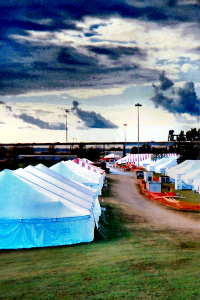 where I would live most of the time. The location was about 2 city blocks large next to a lock on a shipping channel. The sleeping tents and mess tents are huge, floored in plywood --think circus with no acrobats.
 They are air-conditioned with octopus-like portable units using 18-inch diameter tubes similar to the flexible plastic vents one can get for a dryer. The food is great, and the opportunity to commune with a broad range of folks and watch their comings and goings was good. We had to leave our tent city for three days during hurricane Rita and felt like we were coming home when we returned.
Phase Three, Slow down and wait.
On our second day of waiting for assignment we volunteered for a new effort –get the thousands of sheltered people out of shelters into the thousands of travel trailers that were headed for Louisiana. This was the 15th. Until a few days before I came home, this project had few trailers to fill –none for the first week. Our initial group of ten or so grew to about 20 as several firefighters were added. Needless to say, frustrations grew. The next day about 10 of us went to a shelter at Nichols State University in Thibodaux, about 35 miles west of New Orleans. We practiced filling out the simple form needed to register people for possible moves to trailers. There were about 1000 people sheltered on campus in 2 gymnasiums and Catholic center, but we were in the infirmary that had about 100 patients in what is supposed to be the nursing school. Thousands more people came through Nichols State during evacuation. Most were fed and put on busses to Houston or as far as Michigan. The staff and leadership at the shelter was impressive --a combination of local public health people and visiting disaster medical teams. In the psych. area I interviewed a Cuban man who knew little other than that he had arrived on a boat two years earlier. Another was just getting his memory back after rescuing himself, his dog, and helping in the rescue of others. Most poignant was my talk with a 54 year old woman who looked 70. She was worried that her mother might be looking for her. The mother had had an abdominal operation in Charity hospital a day or two before Katrina. I knew as I spoke to her that more than thirty bodies had been found at this hospital. Because of their infirmities, most of the people we met needed a move to a medical facility, not a trailer. But, I am glad for my brief contact with reality.
Phase Four: One day in the ruins.
The next day, in another make-work activity, three of us went to look at sites on our list of trailer sites we might be serving. The sites we saw were destined for institutional or industrial employees and would not be part of our program, but the journey took us through some of the worst of the damaged areas. In East New Orleans the water had not only risen but had come with great velocity, walls burst out, cars strewn. This was the first day that residents were being allowed back into some neighborhoods, but we saw nobody but ourselves. Later in the day we got to the French Quarter which felt like a ghost town, except for the military. In between we made it north across Lake Pontchartrain to the town of Slidell. We were in search of a good map, and had heard the Wal-Mart was open in the neighboring town. Slidell, ravaged by wind and surging water was worse than anything I could have imagined: shanties and million-dollar homes, splintered and strewn across the landscape. I saw boats on house tops and in trees. Debris was plowed off the roads like snow –everything looking like a badly designed set from a disaster movie. When we got to the Wal-Mart, business was so brisk that that there was an “in” door and “out” door. We made another stop at a pharmacy and saw no signs of price gouging.We did see hundreds of signs put up by storm chasing contractors wanting to be hired to fix people’s homes, and saw cars of individuals and groups who had shown up with tools and good-will to lend a free hand to anybody who needed it. They had signs like: “Minnesota here to Help.” I took no pictures, not wanting to be a tourist, and decided I didn’t need to go back unless my job took me there. It didn’t.
Phase Five: Jumping ship to planning 101
People in our group (some Peace Corps volunteers, a great contingent of immigration people from Vermont, D.C., and elsewhere) began to look for alternative activities until the trailer project materialized. They would show up each day and find nothing to do, go out to and volunteer for the shelter at the convention center, or an animal shelter, or man the telephones for the group trying to connect folks with missing family members or their identified remains. I tended to be off doing some small task or following a false-trailer alarm when these ventures materialized so I missed them. Consequently, I was one of the first of many to jump ship. On the 21st I offered my planning services to folks “on the 4th floor” who were trying to get something better than trailer slums out of the FEMA effort. I started work with them the next day --regretting the loss of opportunity to give direct service but seeking to make a contribution. From that day until my departure on October 8th, I helped Jorge, a planner consultant from Florida, work on schemes that would accommodate temporary trailers as transitional housing for evacuees but which (by installing utilities in a useful pattern) could evolve to permanent neighborhoods in the host communities. It was an exercise in neo-traditional planning. I was among good and intelligent people. It was my first-ever experience in a giant office space equipped with cubicles. The 4th floor houses groups ranging from our little project to the Disaster Mortuary team. There are several contractors present who are part of the housing effort. However, nobody seemed to have a clear idea of how the housing program worked or was supposed to work. This is the reason why there must be a hyphen in “bureau-cracy.” It began to be my fun-and-frustration game to ask people “who does this?” or “how does this happen?” Usually the answer was, “I don’t know.” The problem with our project is that FEMA by law is not supposed to install permanent improvements. The federal programs that do fund such tend to be slow. This tiny little exercise in planning 101 had everybody excited, but I left not knowing how we were actually going to pull it off. I developed a friendship with Jorge and could possibly go back as part of the long-term planning team but will observe from a distance for a few months before giving that serious consideration.
Phase Six: After thirty days.
I was eager to come home but found it somewhat hard to say goodbye to those who left before me and those who remained. I met and worked with fine people whom I am unlikely to see again. Most of the Peace Corp volunteers wound up in challenging assignments. Many did what we were trained to do and dealt with the hopes and frustrations of evacuees daily. Some worked under excellent FEMA leadership, others no. A few extended their service. I shared in their emotions, satisfactions, and frustrations -- as well as in the stories of others who came in and out of my little tent city.Now our attention goes to disasters in Pakistan and Central America. Marney and I wonder if Crisis Corps might take us back to Guatemala where we began in 1967.
Thanks for listening.
They are air-conditioned with octopus-like portable units using 18-inch diameter tubes similar to the flexible plastic vents one can get for a dryer. The food is great, and the opportunity to commune with a broad range of folks and watch their comings and goings was good. We had to leave our tent city for three days during hurricane Rita and felt like we were coming home when we returned.
Phase Three, Slow down and wait.
On our second day of waiting for assignment we volunteered for a new effort –get the thousands of sheltered people out of shelters into the thousands of travel trailers that were headed for Louisiana. This was the 15th. Until a few days before I came home, this project had few trailers to fill –none for the first week. Our initial group of ten or so grew to about 20 as several firefighters were added. Needless to say, frustrations grew. The next day about 10 of us went to a shelter at Nichols State University in Thibodaux, about 35 miles west of New Orleans. We practiced filling out the simple form needed to register people for possible moves to trailers. There were about 1000 people sheltered on campus in 2 gymnasiums and Catholic center, but we were in the infirmary that had about 100 patients in what is supposed to be the nursing school. Thousands more people came through Nichols State during evacuation. Most were fed and put on busses to Houston or as far as Michigan. The staff and leadership at the shelter was impressive --a combination of local public health people and visiting disaster medical teams. In the psych. area I interviewed a Cuban man who knew little other than that he had arrived on a boat two years earlier. Another was just getting his memory back after rescuing himself, his dog, and helping in the rescue of others. Most poignant was my talk with a 54 year old woman who looked 70. She was worried that her mother might be looking for her. The mother had had an abdominal operation in Charity hospital a day or two before Katrina. I knew as I spoke to her that more than thirty bodies had been found at this hospital. Because of their infirmities, most of the people we met needed a move to a medical facility, not a trailer. But, I am glad for my brief contact with reality.
Phase Four: One day in the ruins.
The next day, in another make-work activity, three of us went to look at sites on our list of trailer sites we might be serving. The sites we saw were destined for institutional or industrial employees and would not be part of our program, but the journey took us through some of the worst of the damaged areas. In East New Orleans the water had not only risen but had come with great velocity, walls burst out, cars strewn. This was the first day that residents were being allowed back into some neighborhoods, but we saw nobody but ourselves. Later in the day we got to the French Quarter which felt like a ghost town, except for the military. In between we made it north across Lake Pontchartrain to the town of Slidell. We were in search of a good map, and had heard the Wal-Mart was open in the neighboring town. Slidell, ravaged by wind and surging water was worse than anything I could have imagined: shanties and million-dollar homes, splintered and strewn across the landscape. I saw boats on house tops and in trees. Debris was plowed off the roads like snow –everything looking like a badly designed set from a disaster movie. When we got to the Wal-Mart, business was so brisk that that there was an “in” door and “out” door. We made another stop at a pharmacy and saw no signs of price gouging.We did see hundreds of signs put up by storm chasing contractors wanting to be hired to fix people’s homes, and saw cars of individuals and groups who had shown up with tools and good-will to lend a free hand to anybody who needed it. They had signs like: “Minnesota here to Help.” I took no pictures, not wanting to be a tourist, and decided I didn’t need to go back unless my job took me there. It didn’t.
Phase Five: Jumping ship to planning 101
People in our group (some Peace Corps volunteers, a great contingent of immigration people from Vermont, D.C., and elsewhere) began to look for alternative activities until the trailer project materialized. They would show up each day and find nothing to do, go out to and volunteer for the shelter at the convention center, or an animal shelter, or man the telephones for the group trying to connect folks with missing family members or their identified remains. I tended to be off doing some small task or following a false-trailer alarm when these ventures materialized so I missed them. Consequently, I was one of the first of many to jump ship. On the 21st I offered my planning services to folks “on the 4th floor” who were trying to get something better than trailer slums out of the FEMA effort. I started work with them the next day --regretting the loss of opportunity to give direct service but seeking to make a contribution. From that day until my departure on October 8th, I helped Jorge, a planner consultant from Florida, work on schemes that would accommodate temporary trailers as transitional housing for evacuees but which (by installing utilities in a useful pattern) could evolve to permanent neighborhoods in the host communities. It was an exercise in neo-traditional planning. I was among good and intelligent people. It was my first-ever experience in a giant office space equipped with cubicles. The 4th floor houses groups ranging from our little project to the Disaster Mortuary team. There are several contractors present who are part of the housing effort. However, nobody seemed to have a clear idea of how the housing program worked or was supposed to work. This is the reason why there must be a hyphen in “bureau-cracy.” It began to be my fun-and-frustration game to ask people “who does this?” or “how does this happen?” Usually the answer was, “I don’t know.” The problem with our project is that FEMA by law is not supposed to install permanent improvements. The federal programs that do fund such tend to be slow. This tiny little exercise in planning 101 had everybody excited, but I left not knowing how we were actually going to pull it off. I developed a friendship with Jorge and could possibly go back as part of the long-term planning team but will observe from a distance for a few months before giving that serious consideration.
Phase Six: After thirty days.
I was eager to come home but found it somewhat hard to say goodbye to those who left before me and those who remained. I met and worked with fine people whom I am unlikely to see again. Most of the Peace Corp volunteers wound up in challenging assignments. Many did what we were trained to do and dealt with the hopes and frustrations of evacuees daily. Some worked under excellent FEMA leadership, others no. A few extended their service. I shared in their emotions, satisfactions, and frustrations -- as well as in the stories of others who came in and out of my little tent city.Now our attention goes to disasters in Pakistan and Central America. Marney and I wonder if Crisis Corps might take us back to Guatemala where we began in 1967.
Thanks for listening.
 folks in the field I experienced success and frustrations, saw both the competence and incompetence of FEMA, and decided to add a hyphen in “bureau-cracy.” Technically, this was a “Crisis Corps” assignment –for people who have done their two years of Peace Corps. But since, nobody has ever heard of the Crisis Corps, we were “Peace Corps.” I picked up a cotton hat at K-mart before leaving, turned it inside out, wrote “Peace Corps” on the band and wore it most of my waking hours. That was partly to identify myself with Peace Corps, often to keep sun out of my eyes, but mostly to control my hair which I didn’t have a chance to cut before going and which went crazy in the heat and humidity.
Phase One, Training.
folks in the field I experienced success and frustrations, saw both the competence and incompetence of FEMA, and decided to add a hyphen in “bureau-cracy.” Technically, this was a “Crisis Corps” assignment –for people who have done their two years of Peace Corps. But since, nobody has ever heard of the Crisis Corps, we were “Peace Corps.” I picked up a cotton hat at K-mart before leaving, turned it inside out, wrote “Peace Corps” on the band and wore it most of my waking hours. That was partly to identify myself with Peace Corps, often to keep sun out of my eyes, but mostly to control my hair which I didn’t have a chance to cut before going and which went crazy in the heat and humidity.
Phase One, Training.I arrived in Orlando about 5pm on the 9th. That made me a part of the group of 14 former Peace Corps volunteers called “9-10,” because we registered with FEMA on the 10th. Had I arrived a few hours earlier I would have been a 9-9, and gone with them to Mississippi. After finger printing and ID-tagging on the 10th we did two days of training on the 11th and 12th. We were part of a 100 person training class -- the others mostly from Homeland Security agencies such as Customs and Immigration. It had been a 3-day course, but they cut it down with pressure from above and below. We were trained to handle FEMA Individual Assistance in the field --tying into the FEMA computer system. One funny moment for me was when they handed us three pages of acronyms we had to know to speak the language. Our instructors couldn’t understand why some of us laughed. Other than a hot-humid walk into the neighborhood and around a lake behind the motel I didn’t see much of Orlando. This was the beginning of 30 days in which my love of being a pedestrian was frustrated by places that don’t seem to know such a species exists. At our hotel, there was a pool and a free happy hour, so we had plenty of evening time to get to know each other, the groups ahead of us and those coming behind us.
Phase Two, Wait, Hurry up and wait. We got our assignment to Baton Rouge about 5pm on the 12th, but travel arrangements were impossible for most of us until the 14th. So many people were trying to leave Orlando, and so many more were trying to get near the Katrina impact area. At the Baton Rouge airport, to our surprise, there were rental cars. As we left in a van rented by one Peace Corps volunteer we saw the auto-haul trucks that the rental agencies were using to bring in hundreds of cars. Baton Rouge has about doubled in population from Evacuees and helpers so traffic jams were the norm most hours, most days. When we reported to the JFO (FEMA headquarters, the Joint Field Office, which is in a large, defunct shopping center near downtown Baton Rouge), we were ushered to two long rows of tables where we joined others who had come to know the tables well waiting for job assignments. We were greeted by Debbie who showed obvious frustration with being assigned the task to find work for the hoards arriving. For those of us trained in Individual Assistance the problem was that we should work in DRCs (disaster recovery centers), but they require buildings, leases, utilities, phones. There weren’t many open. Nevertheless, we began the rhythm of 12-hour days seven days a week. We went across the river to the tent city in Port Allen where I would live most of the time. The location was about 2 city blocks large next to a lock on a shipping channel. The sleeping tents and mess tents are huge, floored in plywood --think circus with no acrobats.
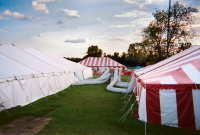 They are air-conditioned with octopus-like portable units using 18-inch diameter tubes similar to the flexible plastic vents one can get for a dryer. The food is great, and the opportunity to commune with a broad range of folks and watch their comings and goings was good. We had to leave our tent city for three days during hurricane Rita and felt like we were coming home when we returned.
Phase Three, Slow down and wait.
On our second day of waiting for assignment we volunteered for a new effort –get the thousands of sheltered people out of shelters into the thousands of travel trailers that were headed for Louisiana. This was the 15th. Until a few days before I came home, this project had few trailers to fill –none for the first week. Our initial group of ten or so grew to about 20 as several firefighters were added. Needless to say, frustrations grew. The next day about 10 of us went to a shelter at Nichols State University in Thibodaux, about 35 miles west of New Orleans. We practiced filling out the simple form needed to register people for possible moves to trailers. There were about 1000 people sheltered on campus in 2 gymnasiums and Catholic center, but we were in the infirmary that had about 100 patients in what is supposed to be the nursing school. Thousands more people came through Nichols State during evacuation. Most were fed and put on busses to Houston or as far as Michigan. The staff and leadership at the shelter was impressive --a combination of local public health people and visiting disaster medical teams. In the psych. area I interviewed a Cuban man who knew little other than that he had arrived on a boat two years earlier. Another was just getting his memory back after rescuing himself, his dog, and helping in the rescue of others. Most poignant was my talk with a 54 year old woman who looked 70. She was worried that her mother might be looking for her. The mother had had an abdominal operation in Charity hospital a day or two before Katrina. I knew as I spoke to her that more than thirty bodies had been found at this hospital. Because of their infirmities, most of the people we met needed a move to a medical facility, not a trailer. But, I am glad for my brief contact with reality.
Phase Four: One day in the ruins.
The next day, in another make-work activity, three of us went to look at sites on our list of trailer sites we might be serving. The sites we saw were destined for institutional or industrial employees and would not be part of our program, but the journey took us through some of the worst of the damaged areas. In East New Orleans the water had not only risen but had come with great velocity, walls burst out, cars strewn. This was the first day that residents were being allowed back into some neighborhoods, but we saw nobody but ourselves. Later in the day we got to the French Quarter which felt like a ghost town, except for the military. In between we made it north across Lake Pontchartrain to the town of Slidell. We were in search of a good map, and had heard the Wal-Mart was open in the neighboring town. Slidell, ravaged by wind and surging water was worse than anything I could have imagined: shanties and million-dollar homes, splintered and strewn across the landscape. I saw boats on house tops and in trees. Debris was plowed off the roads like snow –everything looking like a badly designed set from a disaster movie. When we got to the Wal-Mart, business was so brisk that that there was an “in” door and “out” door. We made another stop at a pharmacy and saw no signs of price gouging.We did see hundreds of signs put up by storm chasing contractors wanting to be hired to fix people’s homes, and saw cars of individuals and groups who had shown up with tools and good-will to lend a free hand to anybody who needed it. They had signs like: “Minnesota here to Help.” I took no pictures, not wanting to be a tourist, and decided I didn’t need to go back unless my job took me there. It didn’t.
Phase Five: Jumping ship to planning 101
People in our group (some Peace Corps volunteers, a great contingent of immigration people from Vermont, D.C., and elsewhere) began to look for alternative activities until the trailer project materialized. They would show up each day and find nothing to do, go out to and volunteer for the shelter at the convention center, or an animal shelter, or man the telephones for the group trying to connect folks with missing family members or their identified remains. I tended to be off doing some small task or following a false-trailer alarm when these ventures materialized so I missed them. Consequently, I was one of the first of many to jump ship. On the 21st I offered my planning services to folks “on the 4th floor” who were trying to get something better than trailer slums out of the FEMA effort. I started work with them the next day --regretting the loss of opportunity to give direct service but seeking to make a contribution. From that day until my departure on October 8th, I helped Jorge, a planner consultant from Florida, work on schemes that would accommodate temporary trailers as transitional housing for evacuees but which (by installing utilities in a useful pattern) could evolve to permanent neighborhoods in the host communities. It was an exercise in neo-traditional planning. I was among good and intelligent people. It was my first-ever experience in a giant office space equipped with cubicles. The 4th floor houses groups ranging from our little project to the Disaster Mortuary team. There are several contractors present who are part of the housing effort. However, nobody seemed to have a clear idea of how the housing program worked or was supposed to work. This is the reason why there must be a hyphen in “bureau-cracy.” It began to be my fun-and-frustration game to ask people “who does this?” or “how does this happen?” Usually the answer was, “I don’t know.” The problem with our project is that FEMA by law is not supposed to install permanent improvements. The federal programs that do fund such tend to be slow. This tiny little exercise in planning 101 had everybody excited, but I left not knowing how we were actually going to pull it off. I developed a friendship with Jorge and could possibly go back as part of the long-term planning team but will observe from a distance for a few months before giving that serious consideration.
Phase Six: After thirty days.
I was eager to come home but found it somewhat hard to say goodbye to those who left before me and those who remained. I met and worked with fine people whom I am unlikely to see again. Most of the Peace Corp volunteers wound up in challenging assignments. Many did what we were trained to do and dealt with the hopes and frustrations of evacuees daily. Some worked under excellent FEMA leadership, others no. A few extended their service. I shared in their emotions, satisfactions, and frustrations -- as well as in the stories of others who came in and out of my little tent city.Now our attention goes to disasters in Pakistan and Central America. Marney and I wonder if Crisis Corps might take us back to Guatemala where we began in 1967.
Thanks for listening.
They are air-conditioned with octopus-like portable units using 18-inch diameter tubes similar to the flexible plastic vents one can get for a dryer. The food is great, and the opportunity to commune with a broad range of folks and watch their comings and goings was good. We had to leave our tent city for three days during hurricane Rita and felt like we were coming home when we returned.
Phase Three, Slow down and wait.
On our second day of waiting for assignment we volunteered for a new effort –get the thousands of sheltered people out of shelters into the thousands of travel trailers that were headed for Louisiana. This was the 15th. Until a few days before I came home, this project had few trailers to fill –none for the first week. Our initial group of ten or so grew to about 20 as several firefighters were added. Needless to say, frustrations grew. The next day about 10 of us went to a shelter at Nichols State University in Thibodaux, about 35 miles west of New Orleans. We practiced filling out the simple form needed to register people for possible moves to trailers. There were about 1000 people sheltered on campus in 2 gymnasiums and Catholic center, but we were in the infirmary that had about 100 patients in what is supposed to be the nursing school. Thousands more people came through Nichols State during evacuation. Most were fed and put on busses to Houston or as far as Michigan. The staff and leadership at the shelter was impressive --a combination of local public health people and visiting disaster medical teams. In the psych. area I interviewed a Cuban man who knew little other than that he had arrived on a boat two years earlier. Another was just getting his memory back after rescuing himself, his dog, and helping in the rescue of others. Most poignant was my talk with a 54 year old woman who looked 70. She was worried that her mother might be looking for her. The mother had had an abdominal operation in Charity hospital a day or two before Katrina. I knew as I spoke to her that more than thirty bodies had been found at this hospital. Because of their infirmities, most of the people we met needed a move to a medical facility, not a trailer. But, I am glad for my brief contact with reality.
Phase Four: One day in the ruins.
The next day, in another make-work activity, three of us went to look at sites on our list of trailer sites we might be serving. The sites we saw were destined for institutional or industrial employees and would not be part of our program, but the journey took us through some of the worst of the damaged areas. In East New Orleans the water had not only risen but had come with great velocity, walls burst out, cars strewn. This was the first day that residents were being allowed back into some neighborhoods, but we saw nobody but ourselves. Later in the day we got to the French Quarter which felt like a ghost town, except for the military. In between we made it north across Lake Pontchartrain to the town of Slidell. We were in search of a good map, and had heard the Wal-Mart was open in the neighboring town. Slidell, ravaged by wind and surging water was worse than anything I could have imagined: shanties and million-dollar homes, splintered and strewn across the landscape. I saw boats on house tops and in trees. Debris was plowed off the roads like snow –everything looking like a badly designed set from a disaster movie. When we got to the Wal-Mart, business was so brisk that that there was an “in” door and “out” door. We made another stop at a pharmacy and saw no signs of price gouging.We did see hundreds of signs put up by storm chasing contractors wanting to be hired to fix people’s homes, and saw cars of individuals and groups who had shown up with tools and good-will to lend a free hand to anybody who needed it. They had signs like: “Minnesota here to Help.” I took no pictures, not wanting to be a tourist, and decided I didn’t need to go back unless my job took me there. It didn’t.
Phase Five: Jumping ship to planning 101
People in our group (some Peace Corps volunteers, a great contingent of immigration people from Vermont, D.C., and elsewhere) began to look for alternative activities until the trailer project materialized. They would show up each day and find nothing to do, go out to and volunteer for the shelter at the convention center, or an animal shelter, or man the telephones for the group trying to connect folks with missing family members or their identified remains. I tended to be off doing some small task or following a false-trailer alarm when these ventures materialized so I missed them. Consequently, I was one of the first of many to jump ship. On the 21st I offered my planning services to folks “on the 4th floor” who were trying to get something better than trailer slums out of the FEMA effort. I started work with them the next day --regretting the loss of opportunity to give direct service but seeking to make a contribution. From that day until my departure on October 8th, I helped Jorge, a planner consultant from Florida, work on schemes that would accommodate temporary trailers as transitional housing for evacuees but which (by installing utilities in a useful pattern) could evolve to permanent neighborhoods in the host communities. It was an exercise in neo-traditional planning. I was among good and intelligent people. It was my first-ever experience in a giant office space equipped with cubicles. The 4th floor houses groups ranging from our little project to the Disaster Mortuary team. There are several contractors present who are part of the housing effort. However, nobody seemed to have a clear idea of how the housing program worked or was supposed to work. This is the reason why there must be a hyphen in “bureau-cracy.” It began to be my fun-and-frustration game to ask people “who does this?” or “how does this happen?” Usually the answer was, “I don’t know.” The problem with our project is that FEMA by law is not supposed to install permanent improvements. The federal programs that do fund such tend to be slow. This tiny little exercise in planning 101 had everybody excited, but I left not knowing how we were actually going to pull it off. I developed a friendship with Jorge and could possibly go back as part of the long-term planning team but will observe from a distance for a few months before giving that serious consideration.
Phase Six: After thirty days.
I was eager to come home but found it somewhat hard to say goodbye to those who left before me and those who remained. I met and worked with fine people whom I am unlikely to see again. Most of the Peace Corp volunteers wound up in challenging assignments. Many did what we were trained to do and dealt with the hopes and frustrations of evacuees daily. Some worked under excellent FEMA leadership, others no. A few extended their service. I shared in their emotions, satisfactions, and frustrations -- as well as in the stories of others who came in and out of my little tent city.Now our attention goes to disasters in Pakistan and Central America. Marney and I wonder if Crisis Corps might take us back to Guatemala where we began in 1967.
Thanks for listening.
Subscribe to:
Posts (Atom)